About
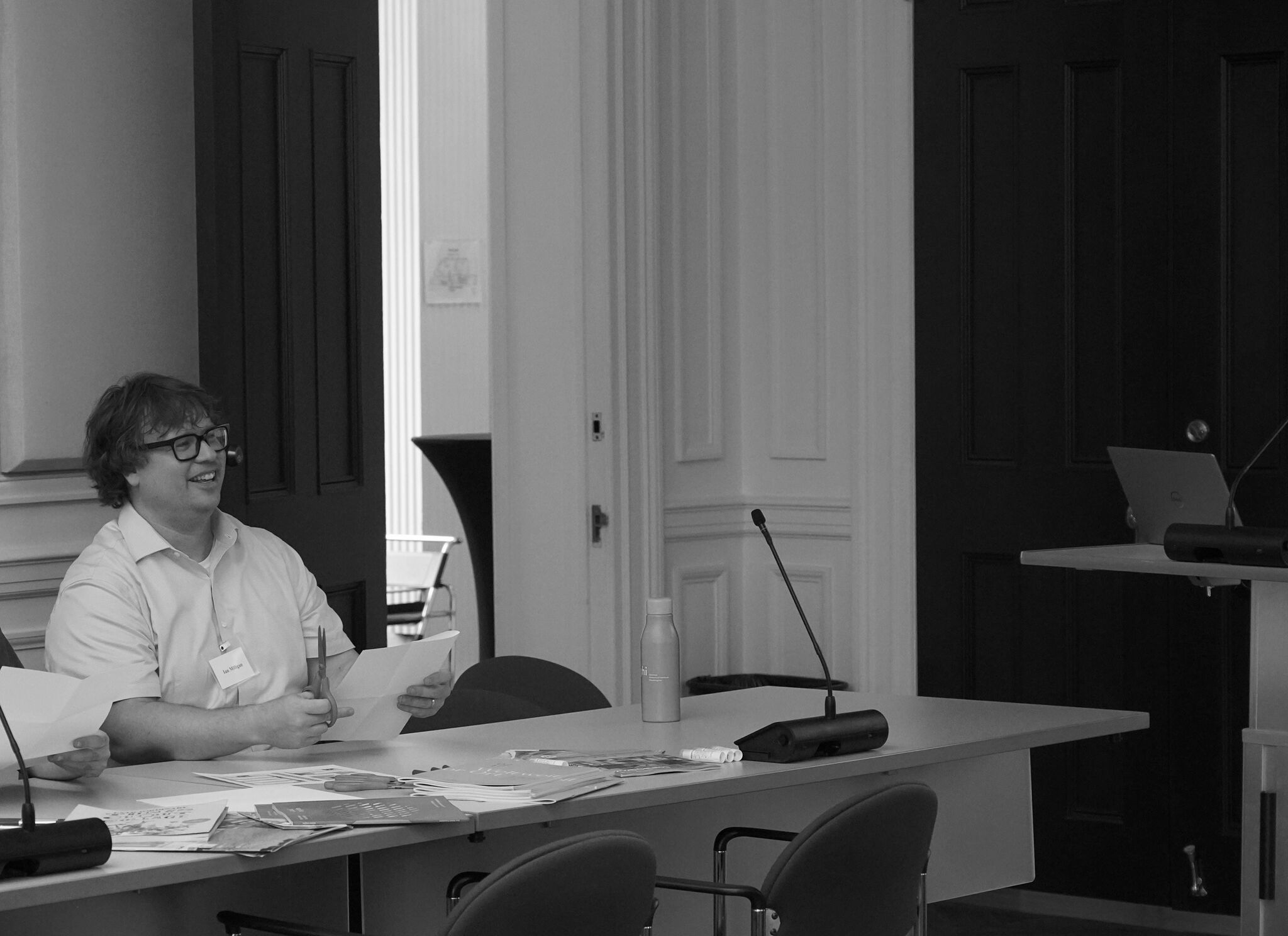
Ian Milligan (he/him) is a Professor of History at the University of Waterloo and a Fellow of the Royal Historical Society. He has authored or co-authored six books, most recently Averting the Digital Dark Age (Johns Hopkins, 2024), and is at work on “On Every Screen” (working title), a history of how ordinary people used the early internet to make sense of the September 11th attacks.
He is the inaugural Director of Waterloo’s School of Social, Political, and Historical Research, which brings together seven departments in the humanities and social sciences. He previously served as Associate Vice-President, Research Oversight & Integrity, providing campus-wide leadership on research ethics, compliance, safeguarding, and research data management. From 2017 to 2023 he led the Archives Unleashed project, an interdisciplinary, multi-institution team whose work is now offered as a service by the Internet Archive.
Research
Milligan’s research explores how web archives and other born-digital traces can be used as historical evidence, and how they are transforming historical practice. His most recent book, Averting the Digital Dark Age: How Archivists, Librarians, and Technologists Built the Web a Memory (Johns Hopkins, 2024), builds on earlier monographs: The Transformation of Historical Research in the Digital Age (Cambridge, 2022), History in the Age of Abundance? (McGill-Queen’s, 2019), which was the subject of an American Historical Review roundtable, and Rebel Youth (UBC Press, 2014), shortlisted for the Canadian Historical Association’s prize for the best scholarly book in Canadian history. He also co-authored Exploring Big Historical Data (2016; 2nd ed. 2022) and co-edited the SAGE Handbook of Web History (2018).
He is currently at work on “On Every Screen” (working title), a new history of the September 11th attacks told through the early internet. Drawing on born-digital sources that scholarship has largely left untouched — pager messages, listserv posts, Flash games, memorial websites, and the edit histories of Wikipedia — it reconstructs how millions of ordinary people made sense of the attacks in real time, building solidarity and spreading conspiracy, mourning and mythologizing through the same networks. The project is supported by a SSHRC Insight Grant. He is co-editor of the journal Internet Histories.
Leadership & Service
As Director of the School of Social, Political, and Historical Research, Milligan leads a school created through the Faculty of Arts’ reorganization into six schools. Appointed to a four-year term beginning in July 2026, he brings together Anthropology, Classical Studies, History, Philosophy, Political Science, Religious Studies, and Sociology & Legal Studies, with a mandate to strengthen interdisciplinary research and teaching while respecting each discipline’s distinct strengths.
As Associate Vice-President (2022–2026) and a member of the University’s Executive Council, he oversaw the Office of Research Ethics, safeguarding research, research health and safety, bibliometrics, and campus research awards, and co-led Waterloo’s Research Data Management strategy through to implementation. He has also served as an elected faculty representative on the Board of Governors and as a two-term Senator.
He has chaired SSHRC’s Insight Development Grants committee for History, served two terms on Library and Archives Canada’s Acquisitions Advisory Committee, and sits on the Canadian Commission for UNESCO’s Memory of the World Advisory Committee and the UCLA Library’s Modern Endangered Archives Program board.
Teaching & Supervision
He has supervised doctoral and master’s students across history, digital humanities, and information science, and has developed courses that bring computational methods into the humanities classroom. At the undergraduate level, he has taught Canadian history, a long history of the internet (stretching back to the printing press), and methods courses for historians and interdisciplinary audiences.
Honours
- Fellow, Royal Historical Society (elected 2022)
- Honourary Archivist Award, Association of Canadian Archivists (2020)
- Arts Excellence in Research Award, University of Waterloo (2019)
- Outstanding Early Career Award, Canadian Society for Digital Humanities (2016)
- Shortlist, CHA Best Scholarly Book in Canadian History Prize, for Rebel Youth (2015)
- Best Article Prize, Journal of the Canadian Historical Association (2013)
- Outstanding Performance Award, University of Waterloo (2014, 2021)
Education
PhD and MA in History, York University; BA (Honours) in History, Queen’s University. He held a SSHRC Postdoctoral Fellowship at Western University, and has been the Marshall McLuhan Centenary Fellow at the University of Toronto and a visiting scholar at the University of Passau.
He lives in Waterloo, Ontario, with his partner and two children.